EPD Climate Declaration
EPD Climate declaration
The single-issue EPDs focus on reporting a single environmental impact category.
The most popular single-issue EPD is the one that focuses on climate impact information such as the carbon footprint of a product in terms of Global Warming Potential (GWP) as measurable carbon dioxide equivalents (CO2 eq.). It is adapted to ISO 14067 for the calculation of carbon footprint (Carbon Footprint).
An EPD climate declaration is based on a complete EPD. That means that all EPDs contain the same climate information but also other so-called environmental impact categories such as e.g. for eutrophication, acidification or ground-level air pollution problems. To publish a single-issue EPD, it is mandatory to have a complete EPD. The Secretariat prepares a climate declaration on a single page based on the information in the original EPD. The climate declaration is then published together with the original EPD.
If a specific product's EPD climate declaration is not available for download, the same information can still be obtained in the EPDs that have been registered.
Search for EPD
Follow this link to search for EPD climate declarations
The history of EPD climate declarations
The concept of climate declaration was introduced by the International EPD System in 2007 and was then named “single-issue EPD” on the market. This concept clarifies that a climate declaration is an EPD according to ISO 14025, but that the information focuses on the product's climate impact.
The international launch of climate declarations took place at the same time as the publication of the ISO standard 14067 on climate footprints (Carbon Footprint) and was therefore somewhat overshadowed by the market's interest in this new standard. However, as the use of ISO 14067 increased, it emerged that it could not be used for different applications where the market requires common and openly available calculation rules, comparability of results and third-party review of the LCA calculations. It is precisely these characteristics that an EPD climate declaration offers.
The International EPD System tried to trademark the name climate declarations in connection with the launch, which was not approved as it is considered a "general term". Unfortunately, therefore, other types of climate declarations may appear on the market but are structured in a different way which means that they cannot be applied in the same way as an EPD climate declaration makes possible. For this reason, the term "EPD climate declaration" is used to distinguish it from other forms of climate declaration.
The special characters with EPD climate declarations
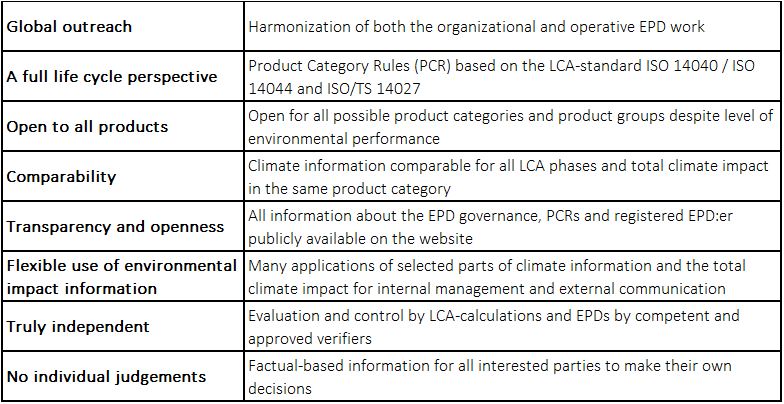
EPD climate declarations are based on the same calculation rules, verification and presentation format as for an EPD. Therefore, EPD climate declarations carry the same characteristics as EPDs, summarized below.
Characteristics for EPD climate declarations
Applicability of EPD climate declarations
EPD climate declarations can be used for a number of applications such as:
- Internal awareness-raising about climate issues
- Background data for development of climate-adapted products
- Background data for internal strategy decisions
- Background data for climate-adapted purchases
- Description of internal work for climate mitigations in annual reports etc.
- Background data for different forms of marketing